Factories Should Not Compare Inverters Without Looking at Peak Demand
A factory can have a beautiful solar production curve and still get hit by painful demand charges. One compressor startup, one simultaneous equipment cycle, or one EV fleet charging window can set the bill tone for the month. That is where the inverter debate needs a wider frame.
The usual inverter comparison is too narrow
Microinverters convert power at the module level. String inverters convert power from grouped panels. In a factory setting, both can be valid depending on roof layout, maintenance strategy, electrical design, and monitoring needs.
But factories and large commercial buildings often care less about panel-level elegance and more about the shape of energy use. A site may need to reduce peak demand, keep production running during outages, or shift energy use into cheaper rate periods. Those goals can make battery energy storage more important than the inverter type alone.
According to the U.S. Energy Information Administration, demand charges are common for commercial and industrial electricity customers and are based on peak power use during a billing interval. That means a short spike can have a long financial tail.
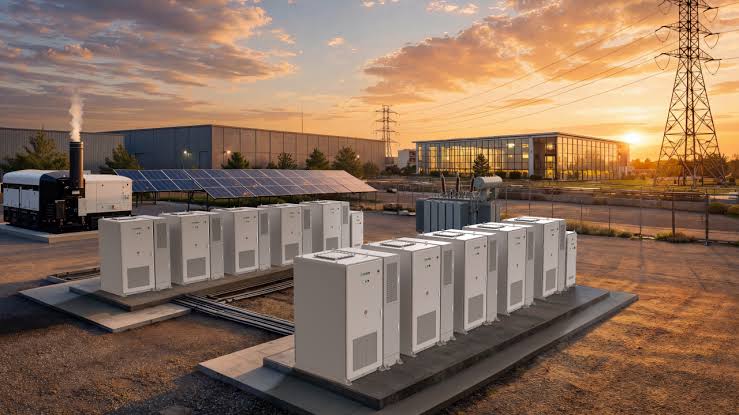
This is why a modular storage system such as SigenStack can be part of a smarter C&I conversation instead of treating solar inverters as the only decision.
What solar can and cannot do by itself
Solar can reduce daytime grid purchases. It can also lower demand if peak usage happens while the sun is strong. But many factories have peaks that do not line up neatly with solar production. Shift changes, cold storage cycles, process equipment, and EV charging can create spikes outside the best solar window.
That is where storage earns attention. A battery energy storage system, or BESS, stores electricity and releases it later. In a factory, it can charge during lower-cost or high-solar periods and discharge when site demand approaches an expensive peak.
According to NREL, behind-the-meter storage can support demand charge management, backup power, and time-of-use optimization when properly sized and controlled. The important phrase is “properly sized.” A battery that is too small may miss the peak. A battery that is too large may sit underused.
A practical factory checklist
Before deciding whether microinverters or string inverters are better, a facility manager should ask:
· When does the site hit its monthly peak?
· Does solar production overlap that peak?
· Are there flexible loads that can be shifted?
· Is backup power needed for critical processes?
· Will EV or forklift charging add new peaks?
· Can storage discharge fast enough to shave demand?
Those questions often lead to a different system design than a simple rooftop solar comparison.
Storage makes the project more controllable
Solar is weather-dependent. Factory loads are schedule-dependent. Utility tariffs are rule-dependent. Storage helps connect those moving parts by giving the site more control over when energy is used.
This does not mean every factory needs a large battery. It means inverter selection should happen after the load profile is understood. A commercial string inverter may be the right solar backbone. Module-level electronics may fit a complicated roof. Storage may be the part that actually changes the bill.
For C&I teams evaluating solar, peak demand, and resilience together, a modular BESS for commercial solar is worth reviewing before limiting the project to an inverter comparison.
The most valuable factory solar design is usually the one that manages peaks, not just the one that produces the most noon kilowatt-hours.