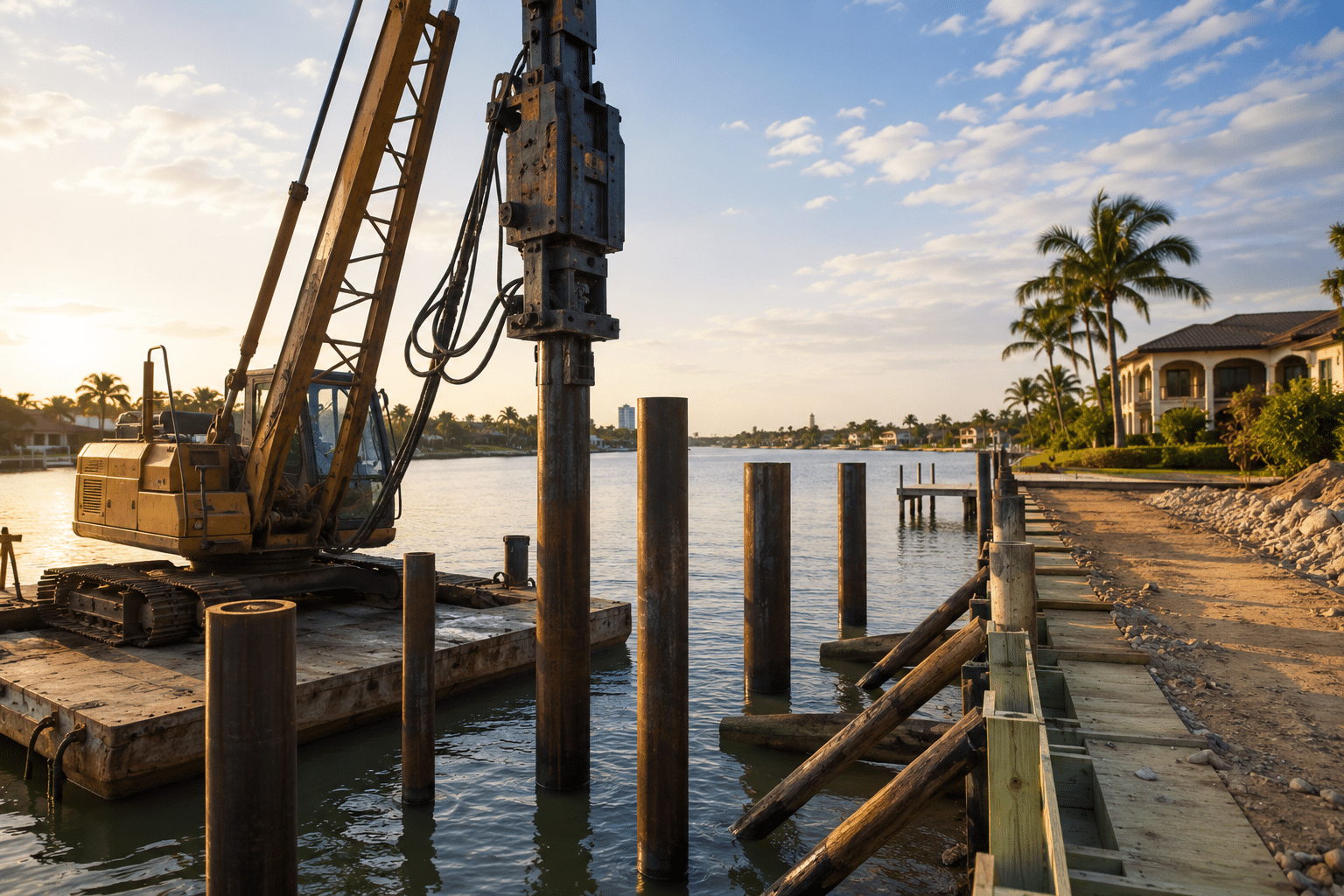
What Affects Pile Installation Cost for Waterfront Projects
Pile installation cost can vary because every waterfront project has its own conditions. The final scope depends on pile type, penetration depth, soil characteristics, water depth, structure load, access, installation method, and the number of piles required. Two docks with the same size can still need different pile systems.
Property owners planning a dock, pier, marina, boat lift, boardwalk, or shoreline structure can review the service details here before comparing cost factors and planning the next stage of construction.
Piling is the foundation of many waterfront structures. If the piles are not deep enough or strong enough, the structure above may become unstable. A cost estimate should therefore consider structural reliability, not only the visible number of posts or the length of the shoreline.
The most accurate planning begins with a site review. Soil type, water depth, expected load, and access conditions all influence equipment needs and installation time. A simple-looking project can become more complex if the soil is weak, the water is deep, or the structure must support heavy loads.
Pile type and material selection
Different pile types have different uses. Wood piles can be practical for private piers and docks. Steel H-piles can support heavier structures and commercial marina conditions. Helical piles may be used where impact methods are not suitable. Concrete supports can be selected for maximum durability in coastal and aggressive environments.
Material affects both cost and performance. A pile that is suitable for a small dock may not be appropriate for a heavy boat lift or shoreline reinforcement project. The structure must be supported by a system designed for its load and the surrounding environment.
Choosing the wrong pile type to reduce upfront cost can lead to movement, early repair, or replacement. Cost comparison should always include expected service conditions, not only the initial installation number.
- Wood piles – often considered for private docks and piers where natural appearance and moderate load support are appropriate.
- Steel H-piles – used when higher load-bearing capacity is needed for commercial marinas, heavy piers, or boat lifts.
- Helical piles – useful where reduced vibration or installation near sensitive structures is important.
- Concrete supports – selected where strength and durability are needed in demanding or aggressive environments.
Soil conditions and bearing capacity
Soil is one of the biggest cost factors in piling work. Sandy and silty soils may be easier to drive through. Clay soils can require more effort. Bedrock can require pre-drilling, which increases time and equipment requirements.
Weak soils may require deeper pile penetration to reach a reliable bearing layer. Dense soils may allow shorter piles, depending on the structure load. The goal is not simply to install a pile to a standard depth. The goal is to reach support that can carry the structure safely.
Soil conditions also affect the installation method. Hydraulic hammers, vibro-drivers, and drilling rigs are used for different situations. The wrong equipment choice can slow the project or create installation problems.
Penetration depth and water depth
Penetration depth affects both material quantity and installation time. Shallow water bodies may require shorter piles, while deep coastal areas may need longer piles to reach a bearing layer. The deeper the required support, the more planning is needed.
Water depth affects how crews and equipment can work. Shallow water may allow simpler access, while deeper areas may require special equipment or work from barges and pontoons. This changes the complexity of the project.
The required depth is also connected to the structure load. A light private pier does not need the same support as a commercial marina or large boat lift. The piles must match both the soil and the structure above.
- Measure water depth – the depth around the project area helps determine pile length and equipment needs.
- Check soil bearing capacity – weak soils may require deeper penetration to reach stable support.
- Define structure load – heavier structures need stronger support and may require more piles or deeper installation.
- Review installation access – working from shore is different from working from water with barges or pontoons.
- Confirm pile quantity – larger projects may use more piles but can sometimes benefit from equipment mobilization efficiency.
Structure load and pile quantity
The load placed on the pile system is a major planning factor. A small residential dock may require fewer piles than a large pier, commercial marina, or boat lift. The design must consider dead load, live load, equipment, vessels, and the way the structure will be used.
Pile quantity is not just a matter of adding more supports. The piles must be placed correctly so the framing above can distribute load. Poor spacing can create weak areas, excessive flex, or difficult connection points.
Large projects may require more piles, but equipment mobilization can become more efficient when the work is planned as a complete system. This is why the full layout should be reviewed before installation starts.
For boat lifts and commercial waterfront structures, load planning is especially important. The piles must support not only the structure but also the dynamic conditions created by water movement, vessel weight, and repeated use.
Access and installation method
Site access can have a significant effect on cost. If crews can work from shore with equipment, installation may be more straightforward. If the site is narrow, landscaped, soft, steep, or blocked by existing structures, the project may require a different approach.
Working from the water can increase complexity because barges, pontoons, or specialized equipment may be needed. This is common when the shoreline does not allow safe or practical access from land.
The installation method must also match the soil. Hydraulic hammers can be faster for standard soils. Vibro-drivers may be effective in dense soils. Drilling rigs may be required where bedrock or difficult conditions are present.
A realistic cost estimate should account for pile material, depth, access, equipment, soil, water depth, structure load, and site preparation. When these factors are reviewed together, the owner can make a better decision and avoid surprises during construction.